


It is sometimes difficult to believe that there are victims who fall for hackers’ tricks and think their PC has been hacked, despite the fact that some hackers are true geniuses who can be used for good or evil. Other times, hackers are just petty criminals who employ techniques that are so embarrassing.
It’s true that none of us are immune from falling victim to a real hacker who steals confidential information and may even demand a ransom to get it back, but occasionally, as in a poker game, they will be completely bluffing and not even be hackers, but rather sleazy con artists who try to exploit fear to trick someone into handing over money.
“We’ve hacked your PC”
The Office of Internet Security issues a warning regarding a campaign of fake emails that extort victims into paying money via cryptocurrencies. This ransom payment is necessary due to the purported hacking of the victim’s computer and the possibility of the exposure of sensitive personal information, which could harm the victim’s reputation and result in damages that are more expensive than the demanded ransom.
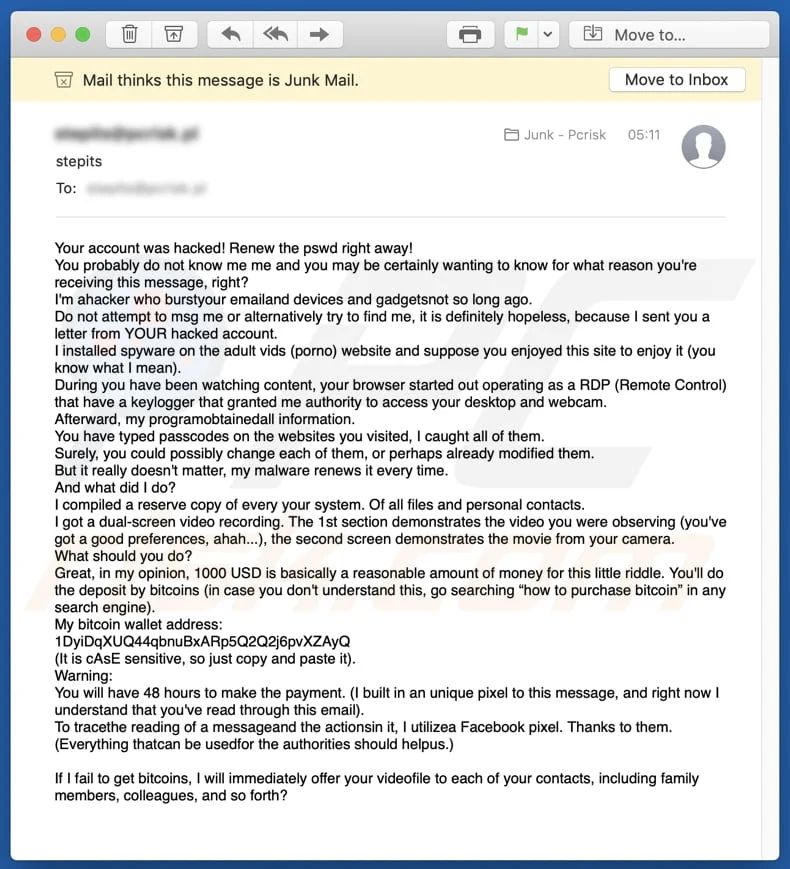
There is an almost 100% chance that your computer has not been infected, they do not have access to your contacts, and there is no intimate video, as seen by the shoddy nature of the purported proof of the hacking. They are using this excuse to terrify you into granting their requests for payment.
Of course, you should check to see if your computer has actually been infected with malware and, if it has, clean it with a security program.
Take the appropriate measures to reset your password if you notice that it was disclosed in the email’s body, but don’t give the reported hack any more credence. This password might have been obtained by a third party in an effort to extort money from another hacker after being made public in a significant leak.
Tips on how to avoid these frauds and scams
The OSI offers a number of recommendations to improve the security of your accounts and equipment and prevent falling for these frauds and scams by giving them less credibility, in addition to warning users to be wary of these emails and the flimsy evidence they present to try to legitimize the hack.
- Unknown or unsolicited emails should be deleted if you get them.
- Maintain antivirus updates on all of your devices.
- In any case, refrain from sending information about your contacts or forwarding letters to stop fraud from spreading.
- Make your passwords more secure by avoiding using the same one across all of the online sites you use.
- When in doubt, speak with the Internet Security Office, INCIBE, or the State Security Forces and Corps immediately.
If you have already paid to recover your purportedly compromised data as a result of your agreement to the blackmail, gather all of your supporting documentation (screenshots, emails, messages, etc.) and report the incident to the State Security Forces and Corps.
“LOL, who falls for these scams anyways? Common sense, people! 😂”
OMG, who falls for these scams? 🙄 Common sense, people! #StayWoke #DontClickThatShadyLink
I can’t believe people still fall for this lame “We’ve hacked your PC” scam. Seriously, have we learned nothing? #Facepalm
Wow, you must be living under a rock if you think everyone is as tech-savvy as you. Scammers are constantly evolving, and some people may not be as knowledgeable as you are. Instead of mocking, why not educate and help prevent others from falling into their traps? #EmpathyWins
Wow, can you believe people actually fall for these “hacked your PC” scams? SMH 🙄
I can’t believe people still fall for these scams! It’s like they never learn. SMH! 🙄
Some people are more trusting or desperate than others. Instead of judging, maybe offer advice or share personal experiences to help educate and protect others. We all make mistakes, so let’s be compassionate and supportive instead of condescending.
“Seriously, who falls for this kind of scam? It’s 2021, people! Wake up!”
Wow, can you believe people actually fall for this “We’ve hacked your PC” scam? It’s mind-boggling! 😂🙈 #StaySafeOnline