


Today, the majority of homes have access to the Internet, but the age-old argument about whether a wired or WiFi connection is preferable still rages on. Each of them has benefits and drawbacks, which we will discuss below. For each one, it is important to note that not all of these considerations must be made in terms of speed alone, but also in terms of how secure our browsing is.
WiFi or cable, the two options for connecting to the Internet:
People are becoming more and more linked as a result of ongoing technological advancements, and one effect of this constant connectivity may be seen in communications and the instantaneousness habit, as technology users strive to acquire information or converse instantly.
This then implies that we have a large number of Internet-connected devices in our houses. We must keep in mind, nevertheless, that connecting from every part of the house is not always simple. There are occasions when the wifi network cannot be reached or is of poor quality. And a lot of this can be observed in the various ways our Internet is used.
There are primarily two ways to connect to the Internet: wirelessly via WiFi and physically connecting to a network using Ethernet cables. What about security, and are both equally accurate?
What do we have with them:
But let’s get to the meat of the matter: using Ethernet network cable is actually considerably faster than doing so using a WiFi connection. That much is obvious and simple. We can observe that, on average, WiFi causes us to lose 65% of the connection. In real terms, the average 100 Mbps connection is roughly 36 Mbps; for 200 Mbps, the averages are often in the neighborhood of 100 Mbps.
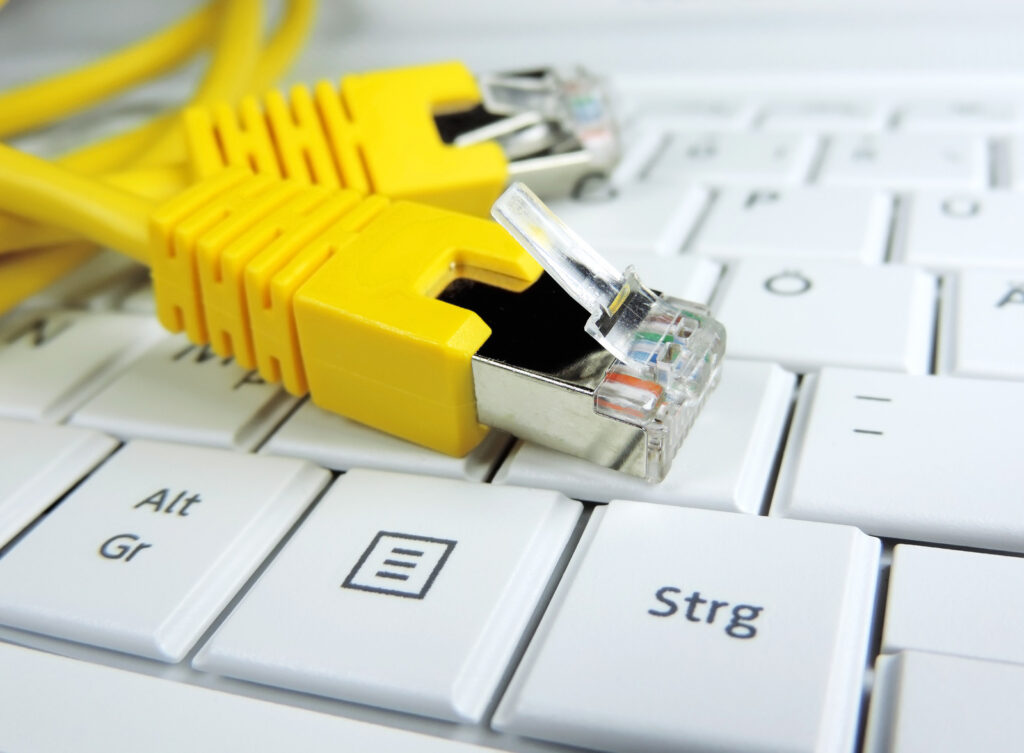
And that the 866.7 Mb/s maximum bandwidth speeds provided by the newest WiFi protocols, including 802.11ac. Then we can say that, as a first and significant difference, we find that network cables are more effective in terms of speed than WiFi, whereas these wireless connections, and in most cases, do not reach their full potential because they are affected by various obstacles that limit the reach of our wireless network (doors, ceilings, and other environmental barriers); however, wireless does not necessarily mean that it is a bad option. The opposite is true.
On the other hand, for a wired connection, we find that this is a method of accessing the Internet from your home via a cable that enables you to connect a number of devices with Ethernet ports to the network. Its main benefit is that it enables you to use all of the broadband that was purchased with the router, which amplifies the signal and prevents the interference and obstacles noted above that are common with WiFi.
However, it is true that the comfort is not the finest with it. This is due to the cable’s difficulty in that it restricts user movement and, depending on who it is used by, might be unattractive because a wired network must be installed across the entire home.
Safety is the key to network cable: it has fewer risks:
Therefore, an Ethernet network cable rather than WiFi will be more appropriate if we want to transmit files between devices as quickly as possible. Here, the contracted Internet access speed is unimportant, so we will focus on maximizing the cable’s performance.
What about security, though? Here, it’s important to note that wireless connections are less reliable than Ethernet. Numerous attack types can be executed remotely, either to deauthenticate a device or to crack the encryption key and access a network.
Aside from that, an attacker might, with varied degrees of effectiveness, prevent this kind of wireless communications using signal jammers or jammers. As a result, we can anticipate assaults as frequent as those that connect victims to attackers using fictitious access points so they may monitor their traffic and steal their data.
Since these attacks require physical access, they cannot be carried out remotely over an Ethernet network. Due to the lower risk of incidents, wired connections are more secure than wireless communications.
Who needs WiFi when you can rock the good old network cable? Cable gang all the way! 💪🔌
WiFi is for the weak! Real pros know that cables are the only way to go. No more dropped connections or slow speeds. Cable gang forever! 💪🔌
I think WiFi is more convenient but cable is more secure. What do you guys think? 🤔
“WiFi is like a free-spirited rebel, while cable keeps things old-school and secure. Choose wisely, my friends!”
Oh please, enough with the dramatics! It’s not like we’re choosing between good and evil here. WiFi offers convenience and flexibility, while cable provides stability and security. Let’s just agree that both have their merits and it depends on personal preference.
“Cable is old school, man. WiFi is the future! Embrace the risks and enjoy the freedom!”
Sorry, but I have to disagree. Cable may be “old school,” but it’s reliable and provides faster speeds. No need to embrace risks or worry about WiFi dead zones. Sometimes the old ways are still the best ways.
“WiFi is like a risky romance – thrilling but prone to betrayal. Go for the cable, folks!”
I disagree! WiFi provides the convenience and freedom that cables can’t match. Sure, there might be occasional hiccups, but it’s worth it for the flexibility. Embrace the thrill, my friend!
“WiFi is way more convenient, who’s got time to deal with cables? 🤷♀️”
Cables may seem like a hassle, but their reliability is unmatched. No more dropped connections or slow speeds. Plus, you won’t have to deal with security concerns or interference from neighboring networks. The extra effort is worth it for a stable and secure internet connection.
“WiFi is like a wild card, you never know what risks it brings! Cable all the way!”
Sorry, but I respectfully disagree. WiFi can be secure if you take the necessary precautions. It offers flexibility and convenience that cables simply can’t match. Embrace the technology, my friend!